
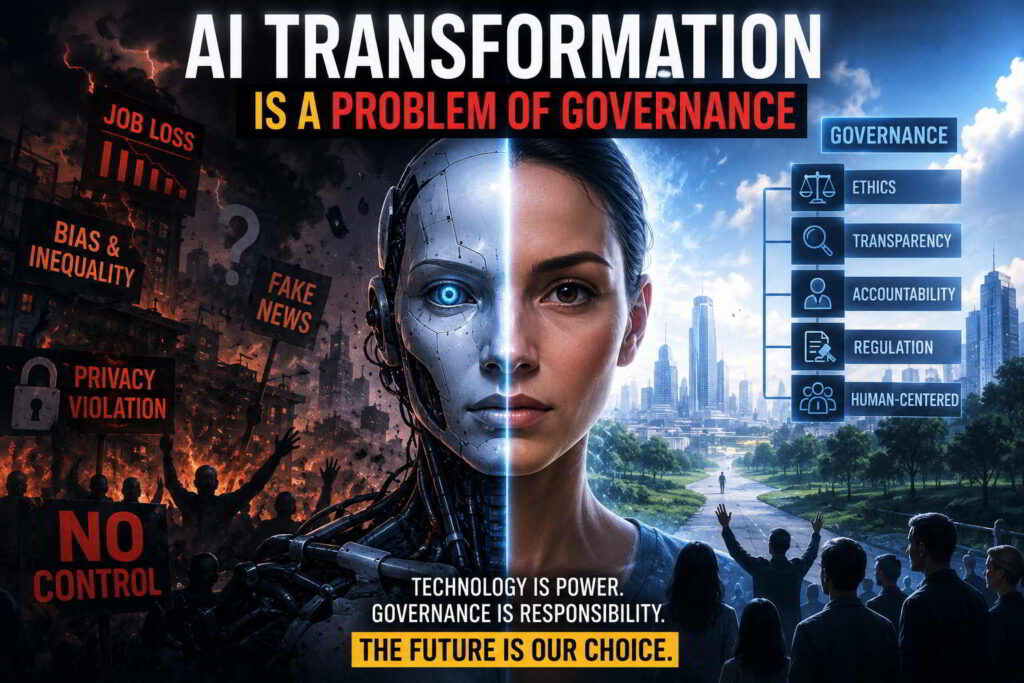
AI Transformation Is a Problem of Governance, Not Technology
Why shifting accountability from engineering pipelines to the boardroom is the only viable path to safely scaling generative systems and eliminating enterprise liabilities.
When modern organizations launch ambitious artificial intelligence initiatives, the strategic narrative is almost always dominated by technology. Executive committees debate which Large Language Model (LLM) to license, whether to build proprietary foundational layers, and how much compute budget to allocate to GPU clustering or cloud instances.
Yet, as pilot projects attempt to migrate from sandboxed staging environments to live enterprise production, these initiatives often hit a brick wall. This operational friction is rarely due to API latency or model parameter limitations. Instead, it is caused by security operations blocking deployments, legal departments raising red flags over training data lineage, and business units struggling to define accountability boundaries when a probabilistic system makes an inaccurate or harmful decision.
This persistent bottleneck highlights a fundamental truth: AI transformation is not a technological problem; it is a problem of governance.
Without unified, comprehensive frameworks to manage systemic risk, defend intellectual property boundaries, and enforce regulatory compliance, deploying advanced AI at scale is an organizational liability. At askchadi.com, we analyze the intersecting vectors of digital transformation, organizational design, and enterprise-grade system integrations. This deep-dive strategic guide provides the foundational blueprints to establish an institutional AI governance framework that mitigates liability while accelerating genuine business value.
The Real AI Bottleneck
Technology is no longer the gating factor of the intelligence revolution. Scalability, systemic trust, and risk mitigation dictate whether generative implementations deliver ROI or structural liabilities. Organizations deploying AI without structured governance face catastrophic exposure.
- The Myth: AI Transformation is a developer-driven technical roadmap.
- The Reality: Successful integration is 80% organizational change, policy mapping, and risk ownership, and only 20% writing code.
- The Objective: Shift from uncoordinated, ad-hoc pilot testing to enterprise-wide, compliant guardrails.
Enterprise AI Risk Taxonomy Matrix
| Risk Category | Core Threat Vector | Governance Mitigation Protocol | Primary Accountability Owner |
|---|---|---|---|
| Data Leakage | Proprietary IP copy-pasted into third-party public models. | Enterprise API sandboxing & strict egress filtering. | Chief Information Security Officer (CISO) |
| Model Hallucinations | LLMs generating factually incorrect, legally binding text. | Retrieval-Augmented Generation (RAG) with “Human-in-the-Loop” verification. | Chief Data Officer (CDO) / Business Unit Head |
| Regulatory Compliance | Non-compliance with the EU AI Act, FTC, or state data laws. | Automated risk classification & model bias audits. | Chief Legal Officer / General Counsel |
| Algorithmic Bias | Models reinforcing historic structural discrimination in hiring or loans. | Continuous training data drift analysis & bias profiling. | Chief Risk Officer (CRO) |
Industry-Standard Governance Blueprints
Organizations should align their governance frameworks with existing, globally recognized standards rather than building guidelines from scratch:
1. The Core Paradigm Shift: From Software to Probabilistic Systems
To build effective governance, organizations must first understand how artificial intelligence differs fundamentally from traditional software architecture.
Historically, IT departments relied on deterministic systems. Software followed explicit, hard-coded logic: if a user executed command A, the system predictably generated output B. Governance in this world was straightforward, relying on static software testing, strict access control lists, and code audits.
In contrast, machine learning and generative AI systems are **probabilistic**. They do not follow fixed rules; instead, they analyze statistical patterns across massive datasets to generate predictive suggestions.
 Traditional Deterministic Software:
   [Input] ──► [Hard-Coded Business Logic Rules] ──► [Highly Predictable Output]

 Modern Probabilistic AI Systems:
   [Input] ──► [Dynamic Statistical Weights (LLM)] ──► [Estimated Probability Output]
This probabilistic nature introduces several unique challenges for traditional IT controls:
- Unpredictability: A generative model can produce a completely different response to the exact same prompt over time, a challenge known as non-deterministic output drift.
- The “Black Box” Problem: Deep neural networks process information through billions of interconnected nodes, making it nearly impossible to trace exactly why a model made a specific prediction.
- Hallucinations: Generative models are designed to find patterns, not verify facts. When they lack enough data, they will often create realistic-sounding but completely fabricated information.
Because of these characteristics, traditional quality assurance and software governance tools are no longer enough. You cannot simply patch an AI model’s code to fix a bug; instead, you must build continuous monitoring and validation systems that oversee its outputs over time.
2. The Threat Vectors of “Shadow AI” and Unregulated Adoption
The rapid rise of consumer-friendly tools has democratized access to advanced artificial intelligence. While this drives grass-roots innovation, it also opens the door to a massive shadow IT challenge: **Shadow AI**.
Every day, employees across departments copy and paste sensitive company data into external, public generative AI platforms to draft emails, clean up messy databases, or write code. This unmonitored adoption exposes organizations to several major risk vectors:
       ENTERPRISE EXPOSURE PATHS FOR UNGOVERNED AI ADOPTION
   ┌──────────────────────┐      ┌────────────────────────┐      ┌──────────────────────┐
   │ Proprietary Data     │ ───► │ Publicly Hosted LLM    │ ───► │ Public Training Pool │
   │ (IP, Financials, HR) │      │ (External AI Provider) │      │ (Used by Competitors)│
   └──────────────────────┘      └────────────────────────┘      └──────────────────────┘
A. Intellectual Property Exfiltration
When employees input proprietary code, internal financials, or client lists into consumer-grade AI tools, that data is often absorbed into public training datasets. This means your sensitive internal assets could easily resurface as suggested outputs for competitors querying the exact same models.
B. Severe Regulatory Non-Compliance
Using third-party AI to process personally identifiable information (PII) or protected health information (PHI) without proper data-processing agreements violates major global privacy frameworks like GDPR, HIPAA, and CCPA. The resulting fines can be devastating for an enterprise.
C. Inaccurate Decision Making
When departments rely on unverified AI outputs for key business decisions—such as financial forecasting or hiring assessments—without a “human-in-the-loop” review process, they risk making critical errors based on hallucinations or biased data.
3. The Modern Enterprise AI Governance Framework
To mitigate these risks without shutting down innovation, companies need to replace reactive bans with a proactive, structured governance framework. An effective framework is built around four core pillars:
Pillar 1: Strategic Alignment and Portfolio Management
Before deploying any AI tool, organizations must clearly define the business problem it is designed to solve and how to measure its return on investment (ROI). Rather than chasing every new AI trend, use a centralized evaluation committee to assess projects based on their business value and risk profile. This ensures your budget is focused on high-impact, manageable initiatives.
Pillar 2: Data Governance and Ingestion Control
Data is the foundation of any successful AI system. To ensure your models produce reliable, compliant outputs, your data team must build robust data pipelines that govern:
- Data Lineage: Tracking exactly where training data comes from and ensuring you have the legal rights to use it.
- Consent Management: Making sure customer or user data is not ingested into training pools without explicit permission.
- Data Quality Control: Filtering out biased, outdated, or inaccurate information from training sets to prevent downstream output errors.
Pillar 3: Algorithmic Accountability and Risk Classification
Not all AI applications carry the same level of risk. Your governance framework should categorize AI tools by risk tier to determine the level of oversight required:
| Risk Tier | Oversight Level Required | Examples |
|---|---|---|
| Tier 1: Prohibited Risk | Prohibited completely (Zero-tolerance compliance). | Biometric scoring, social classification engines. |
| Tier 2: High Risk | Independent auditing, strict access logs, human-in-the-loop. | HR resume screening, automated credit underwriting. |
| Tier 3: Limited Risk | Simple disclosure to users (Transparency compliance). | Internal translation assistance, basic front-line chatbots. |
| Tier 4: Minimal Risk | Standard IT security reviews and access controls. | Spam filtering algorithms, text layout auto-completes. |
Pillar 4: Model Operations (ModelOps) & Continuous Monitoring
AI models are dynamic; they can degrade or drift in accuracy over time as real-world data patterns shift. To combat this, your ModelOps team must set up continuous monitoring tools to track performance, measure output drift, and quickly detect any emerging bias or hallucinations. This ensures your systems remain accurate and secure long after their initial deployment.
Technology teams should not be left to write AI policies in a vacuum. To build a balanced, resilient strategy, organizations should establish a cross-functional **AI Safety Board**. This committee should bring together leaders from Legal, Compliance, Cybersecurity, Human Resources, and individual business units. Meeting regularly, this board is responsible for reviewing high-risk AI use cases, approving new tool requests, and updating internal policies as global regulations evolve.
4. Aligning with Global Regulatory Standards
As artificial intelligence continues to reshape industries, governments around the world are introducing strict new regulations to govern its use. Enterprise leaders must design their internal frameworks to align with these emerging global standards:
The European Union AI Act (EU AI Act)
The EU AI Act is the world’s first comprehensive horizontal regulatory framework for artificial intelligence. It uses a risk-based classification system that imposes strict requirements on “High-Risk” AI systems, including mandatory third-party audits, detailed technical documentation, and robust cybersecurity standards. Crucially, the Act applies to any organization doing business in the EU—regardless of where the company is headquartered—meaning global enterprise operations must prepare for compliance now.
The NIST AI Risk Management Framework (AI RMF)
In the United States, the National Institute of Standards and Technology (NIST) developed the AI RMF to help organizations design, deploy, and manage AI systems responsibly. The framework is built around four key functions:
- GOVERN: Establish a culture of risk management and clear accountability across the organization.
- MAP: Identify and analyze the specific risks associated with each AI system and its deployment context.
- MEASURE: Test, evaluate, and track AI system performance and risk metrics over time.
- MANAGE: Implement continuous controls and mitigation strategies to address identified risks in production.
By building your internal policies around established standards like the NIST AI RMF and ISO/IEC 42001, you can ensure your AI program is ready to adapt to new regulations as they are introduced.
5. Steps to Building a Resilient AI Governance Program
Moving from policy concepts to operational reality requires a structured, step-by-step approach. Here is how to launch a resilient governance program within your organization:
Conclusion: Governance as an Accelerator for Innovation
Many leaders view governance as a bottleneck that slows down progress. In the context of AI transformation, however, the opposite is true.
Without a clear governance framework, organizations are forced to operate in a constant state of hesitation. Security teams block deployments, legal teams stall contracts, and departments hesitate to scale promising pilots because the risks are too high or poorly defined.
Structured governance provides clarity. By establishing clear guardrails, defining accountability, and building robust risk mitigation paths, you give your teams the confidence to innovate quickly and safely.
Ultimately, true AI transformation is not about who has the fastest algorithms; it is about who builds the most trusted, reliable, and compliant systems. In the age of intelligence, the organizations with the strongest governance are the ones that will scale the fastest.