
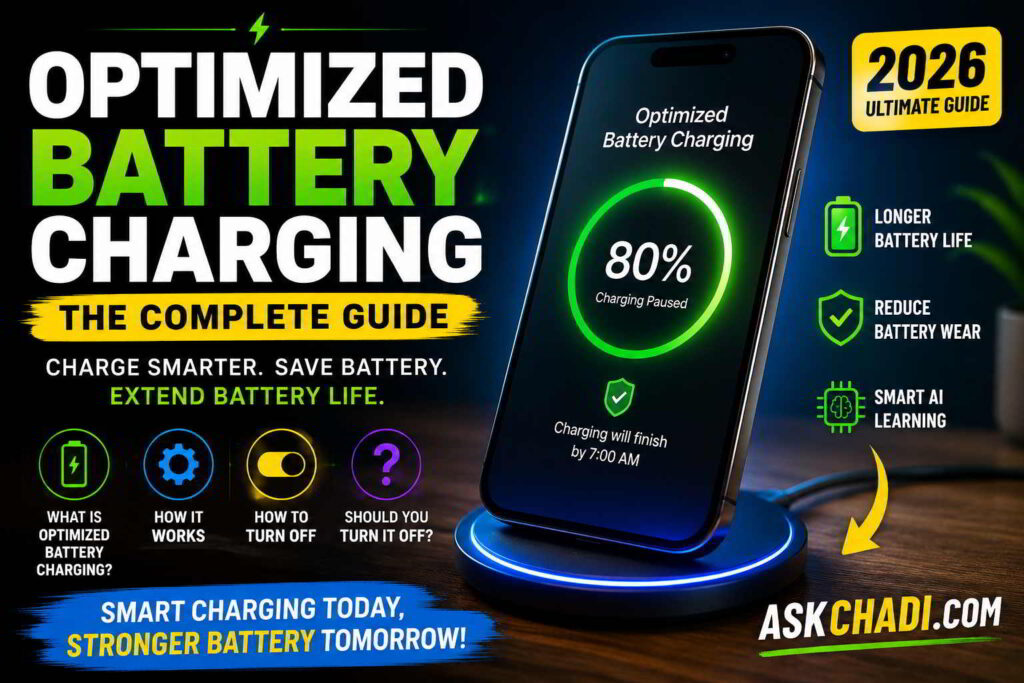
Modern smartphones are becoming smarter every year, and one of the most useful battery-saving features is optimized battery charging. Whether you own an iPhone, Android device, tablet, or laptop, this intelligent charging system is designed to extend battery lifespan while reducing unnecessary battery wear.
Many users wonder:
- what is optimized battery charging
- optimized battery charging iphone
- how to turn off optimized battery charging
- what does optimized battery charging mean
- what is optimizing battery charging
- should turn off optimized battery charging
This guide answers every question while helping you get the most out of your device’s battery.
Table of Contents
Contents
What Is Optimized Battery Charging?. 1
How Does Optimized Battery Charging Work?. 2
Benefits of Optimized Battery Charging. 3
What Does Optimized Battery Charging Mean?. 4
What Is Optimizing Battery Charging?. 4
Why Keeping a Battery at 100% Is Not Ideal 5
Does Optimized Battery Charging Slow Down Charging?. 6
Can Optimized Battery Charging Learn New Habits?. 6
Is Optimized Battery Charging Always Active?. 7
What Is Optimized Battery Charging?
One of the most searched questions today is:
What is optimized battery charging?
Simply put, optimized battery charging is a smart feature that delays charging your battery to 100% until shortly before you normally unplug your device.
Instead of charging immediately to full capacity and staying there for hours, your phone learns your daily charging routine. It pauses charging at around 80%, then finishes charging just before you typically start using the device.
This helps reduce battery aging caused by prolonged exposure to high voltage.
For example:
- You plug in your phone every night at 11 PM.
- You usually wake up at 7 AM.
- The phone charges quickly to around 80%.
- It waits overnight.
- It finishes charging shortly before 7 AM.
This process significantly reduces battery wear over time.
How Does Optimized Battery Charging Work?
The feature uses artificial intelligence and machine learning to understand your charging habits.
It looks at patterns such as:
- Charging times
- Wake-up schedule
- Device usage
- Location (optional on some devices)
- Charging frequency
After learning your routine, your device automatically adjusts the charging speed.
Example Timeline
| Time | Battery Behavior |
| 11:00 PM | Charging begins |
| 11:40 PM | Battery reaches about 80% |
| 12:00 AM–6:00 AM | Charging pauses |
| 6:10 AM | Charging resumes |
| 7:00 AM | Battery reaches 100% |
The result is less stress on the battery.
Why Lithium-Ion Batteries Age
Every modern smartphone uses a lithium-ion battery.
Although these batteries are excellent, they naturally degrade over time.
Battery aging increases because of:
- High temperatures
- Keeping the battery at 100%
- Deep discharges
- Fast charging every day
- Heavy gaming while charging
optimized battery charging minimizes one of the biggest causes: keeping the battery at full charge for long periods.
Benefits of Optimized Battery Charging
1. Longer Battery Lifespan
Charging to 100% and remaining there for hours accelerates battery aging.
Optimized charging reduces this stress.
2. Better Long-Term Performance
A healthier battery means:
- Better screen-on time
- More stable performance
- Fewer unexpected shutdowns
3. Less Heat
Continuous charging generates heat.
Pausing the charging process helps reduce unnecessary heat buildup.
4. Fewer Battery Replacements
Replacing a battery can be expensive.
Maintaining battery health means you may not need a replacement as quickly.
5. Smarter Charging
Instead of following a fixed schedule, your device adapts automatically.
No manual intervention is required.
What Does Optimized Battery Charging Mean?
Many people search:
What does optimized battery charging mean?
It means your device intelligently manages charging to protect battery health.
Rather than always charging immediately to full capacity, the operating system delays the final stage of charging until it’s actually needed.
This reduces chemical aging inside lithium-ion batteries.
In simple words:
It is a battery protection feature rather than a faster charging feature.
What Is Optimizing Battery Charging?
Another common search is:
What is optimizing battery charging?
This phrase refers to the process your device performs while actively protecting the battery.
When your phone displays a message such as:
“Optimizing Battery Charging”
it usually means the device has recognized your charging schedule and is delaying the last portion of charging.
Nothing is wrong with your battery.
Instead, your phone is working exactly as intended.
Why Keeping a Battery at 100% Is Not Ideal
Many people believe charging to 100% all night is harmless.
In reality, lithium-ion batteries experience more stress when held at full capacity for extended periods.
Imagine two scenarios.
Scenario A
Phone reaches 100% at midnight.
It stays at 100% until 8 AM.
Battery stress: High.
Scenario B
Phone reaches 80%.
Waits.
Charges to 100% just before you wake up.
Battery stress: Much lower.
That difference may seem small on a single night, but over hundreds of charging cycles, it can significantly improve battery longevity.
Does Optimized Battery Charging Slow Down Charging?
No.
This is one of the biggest misconceptions.
The charging speed remains the same.
The phone simply delays the final portion of charging.
When charging resumes, it usually charges at normal speed.
Therefore:
- Charging speed ✔
- Battery protection ✔
- Longer lifespan ✔
Can Optimized Battery Charging Learn New Habits?
Yes.
Modern smartphones continuously learn.
If your daily schedule changes because of:
- a new job,
- travel,
- school,
- weekends,
- vacations,
the system gradually adapts.
After several charging cycles, it updates its predictions to match your new routine.
Is Optimized Battery Charging Always Active?
Not necessarily.
Most devices activate the feature only when they detect consistent charging habits.
For example:
- Charging every night at similar times
- Unplugging around the same hour
- Regular daily usage
If your charging schedule is unpredictable, the feature may activate less frequently or not at all.