
An interactive study guide
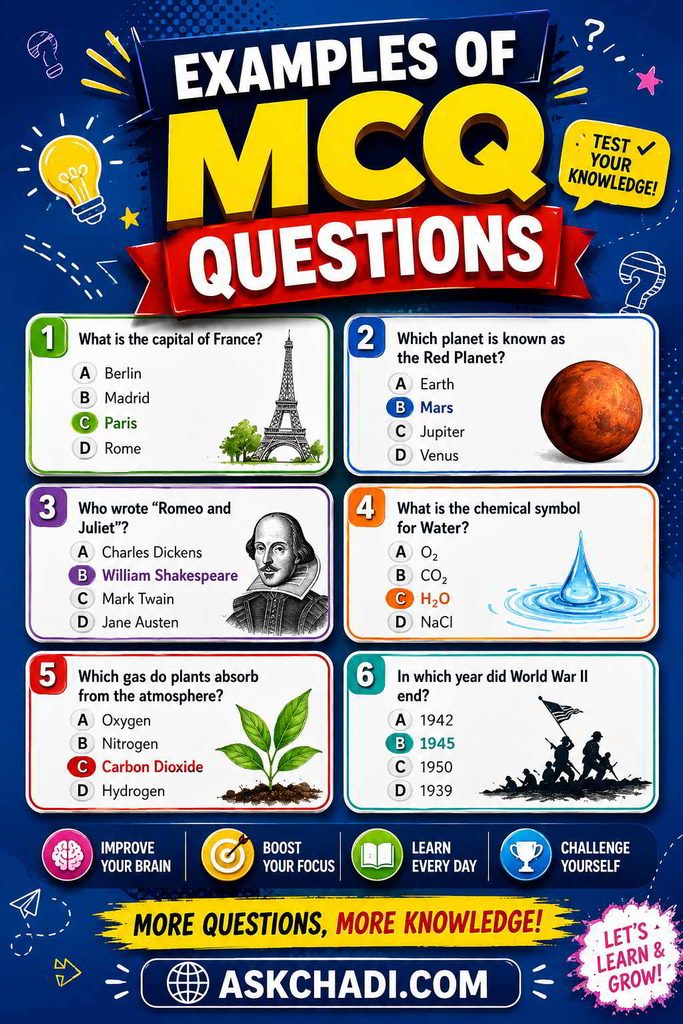
Examples of MCQ
questions.
Study the anatomy of a strong multiple-choice question, then mark your own answers across a 100-question practice bank.
Question → choices → explanation
A short answer
What makes an MCQ work?
A multiple-choice question gives a clear prompt, one best answer, and distractors that are plausible without being trick questions. The best examples test one idea at a time—and explain the reasoning after the choice.
Ask one focused question in language the reader can understand.
Offer four credible options with one unambiguous best answer.
Use the explanation to turn a right or wrong choice into progress.
Examples are useful because they make the invisible structure visible.
Practice lab / 01
Mark your answers.
Choose a round length. We’ll show the answer and the reasoning after every question.
Host’s guide
Make the round fit the room.
Ten questions work for a warm-up. Forty gives a class or team enough variety to find a rhythm. One hundred is the complete workbook: use it for self-study, a question-writing workshop, or several short sessions.
Quick check
A five-minute opener or exit ticket.
Practice round
Enough range for a small group session.
Full workbook
A broad bank across ten topic lanes.
Question-writing checklist
Before you publish an MCQ
- ✓ Is the prompt testing one clear idea?
- ✓ Could a reader understand the question without guessing your intent?
- ✓ Are all four choices plausible and parallel in form?
- ✓ Does the explanation teach something beyond “the answer is…”?
Good distractors reveal the misconception you want the learner to examine.
Topic coverage / 10 lanes
From first principles
to stretch questions.
FAQ
Questions about questions.
Examples of MCQ questions are prompts with a defined best answer and a set of plausible choices. This demo includes ten topic lanes and explanations for every answer.
Four choices are a useful default because they provide variety without creating unnecessary reading load. The right number depends on the audience and assessment goal.
Yes, as a starting point. Review subject-specific answers and adapt the language, difficulty, and accessibility for your learners before formal assessment use.
Write distractors based on likely misconceptions, not random wrong answers. Keep them parallel in grammar and length, then explain the underlying idea.