50 questions.
One living planet.
A field guide to Earth Day history, wild creatures, coral reefs, and the choices that shape our shared home.
Begin the expedition ↓Follow the clues.
Meet the planet.
Fifty carefully chosen questions, from Google Doodles to ocean acidification. Keep your field notes—you’ll find your score waiting at the end.
to explore
Take the Google Earth Day Quiz
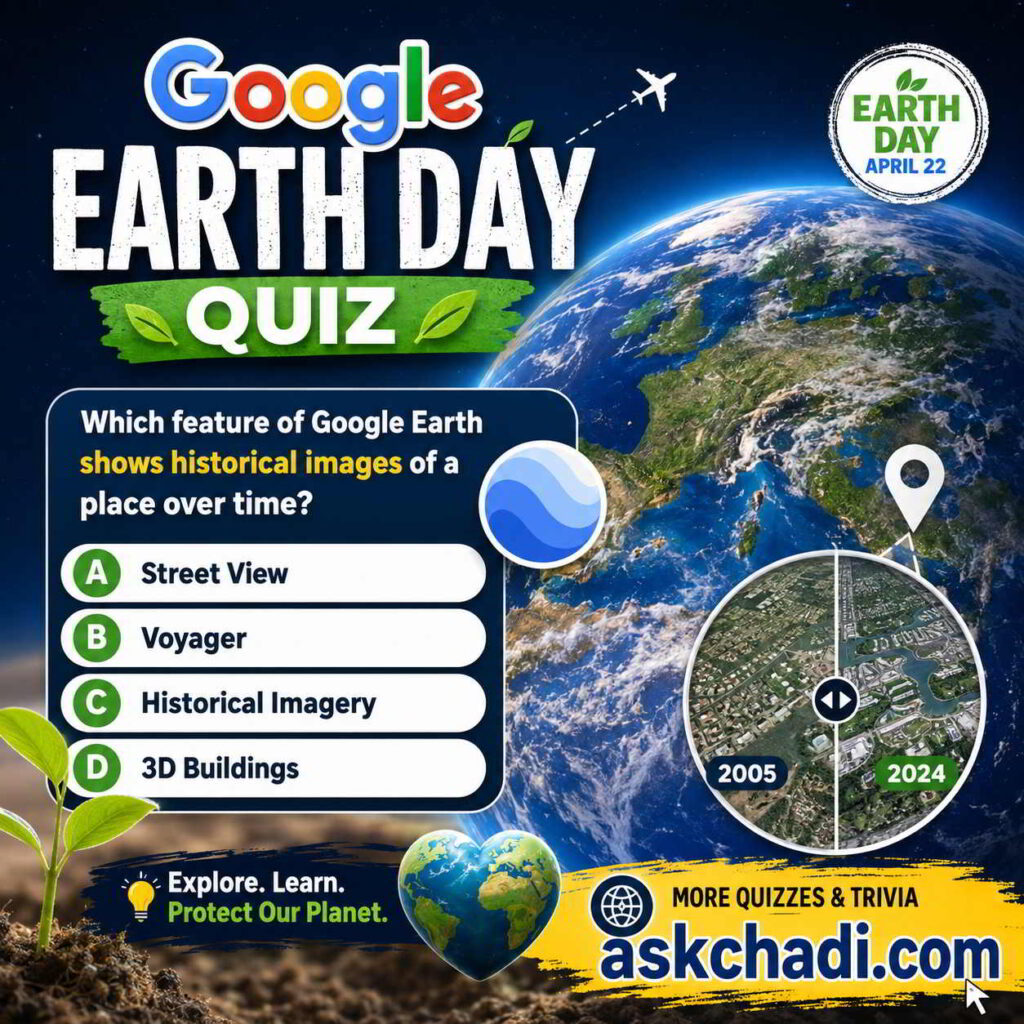
Looking for an engaging Google Earth Day quiz? This 50-question Earth Day trivia challenge combines environmental history, Google Doodles, animals, oceans, climate science, biodiversity, renewable energy, and everyday sustainability. It works as a classroom activity, family game, Earth Day party quiz, or quick personal challenge.
The phrase “Google Earth Day quiz” can refer to more than one experience. Google’s official Earth Day 2015 Doodle invited people to answer a short personality quiz to discover which animal they resembled, while later Earth Day Doodles highlighted real places, biodiversity, and conservation work around the planet.[1] [2] This article is an original, expanded Earth Day trivia quiz—not a claim that this 50-question version is an official Google product.
How to play: Read each question, choose A, B, C, or D, and record your answers before checking the answer key. Give yourself one point for every correct answer. Your final score appears when you total the answer key at the end.
Important: Do not scroll to the answer key until you have finished all 50 questions if you want a fair result.
Part 1: Earth Day History and Google Doodles
1. On which date is Earth Day observed each year?
2. The first widely recognized Earth Day took place in which year?
3. Which U.S. senator helped organize the first Earth Day?
4. Approximately how many people participated in demonstrations associated with the first Earth Day in the United States?
5. Which federal agency was authorized by Congress in December 1970?
6. What is a Google Doodle?
7. What did Google’s Earth Day 2015 Doodle ask users to discover?
8. Which date did Google’s Earth Day 2015 Doodle launch?
9. What was a central theme of Google’s Earth Day 2024 Doodle?
10. In an environmental context, what does biodiversity mean?
a way.
Part 2: Animals and Biodiversity Trivia
11. Which animal is the largest living land animal?
12. Which animal is known for changing color and moving its eyes independently?
13. What is the world’s largest living fish?
14. Which bird is widely recognized as the fastest animal when diving?
15. What do bees collect from flowers to make honey?
16. Which animal is a mammal rather than a fish?
17. What is an animal’s natural home called?
18. Which group contains only pollinators?
19. Why are decomposers important in ecosystems?
20. Which of these is an example of an endangered species?
21. A food web shows what relationship among organisms?
22. What is a keystone species?
23. Which ecosystem is characterized by very low rainfall?
24. Why are wetlands valuable?
25. What does conservation generally mean?
are living worlds.
Part 3: Oceans, Coral, and the “How to Get Coral” Question
26. Are corals plants, rocks, or animals?
27. What gives many healthy corals their vivid colors?
28. What is coral bleaching?
29. Which change can contribute to coral bleaching?
30. What is ocean acidification?
31. About what share of marine species are associated with coral reef ecosystems?
32. Which action is safest for a person visiting a coral reef?
33. What is the best answer to “How do you get coral in the Google Earth Day quiz?”
34. Which habitat is built by reef-forming corals over time?
35. Which factor can harm reefs through runoff from land?
Part 4: Climate Change and Sustainability
36. Which gas is a major greenhouse gas released by burning fossil fuels?
37. Which energy source is renewable?
38. What is energy efficiency?
39. Which action can reduce household electricity use?
40. What is the “reduce, reuse, recycle” hierarchy generally intended to encourage?
41. Which transportation choice usually produces fewer emissions per passenger than driving alone?
42. What is a carbon footprint?
43. Why can recycling save energy and natural resources?
44. What is deforestation?
45. Which practice can help protect soil from erosion?
Part 5: Google Earth Day Quiz Challenge
46. Which Google product is primarily designed for exploring a virtual globe with satellite imagery and geographic information?
47. What does a protected area generally aim to do?
48. The Great Green Wall initiative highlighted in Google’s Earth Day 2024 Doodle is associated with which continent?
49. Which location featured in the Earth Day 2024 Doodle is in Iceland?
50. What is the most useful lesson of an Earth Day trivia quiz?
Google Earth Day Quiz Answers
Use the table below to check your google earth day quiz answers. Each correct response is worth one point, for a maximum score of 50.
| Question | Answer | Question | Answer | Question | Answer | Question | Answer | Question | Answer |
|---|---|---|---|---|---|---|---|---|---|
| 1 | B | 11 | B | 21 | A | 31 | C | 41 | A |
| 2 | C | 12 | A | 22 | A | 32 | A | 42 | A |
| 3 | A | 13 | C | 23 | A | 33 | D | 43 | A |
| 4 | C | 14 | B | 24 | A | 34 | A | 44 | A |
| 5 | C | 15 | A | 25 | A | 35 | A | 45 | A |
| 6 | A | 16 | A | 26 | C | 36 | A | 46 | A |
| 7 | B | 17 | A | 27 | A | 37 | A | 47 | A |
| 8 | C | 18 | A | 28 | A | 38 | A | 48 | A |
| 9 | A | 19 | A | 29 | A | 39 | A | 49 | A |
| 10 | A | 20 | A | 30 | A | 40 | A | 50 | A |
Quick explanations for the trickiest answers
Questions 1–5: Earth Day is observed on April 22, and the first Earth Day took place in 1970. The U.S. Environmental Protection Agency records that Senator Gaylord Nelson helped create the event and that approximately 20 million Americans participated. Congress authorized the EPA later that year.[3]
Questions 6–9: Google’s official Doodle archive describes a Doodle as a celebration presented through a change to the Google logo. The 2015 Earth Day Doodle offered an animal personality quiz, while the 2024 Doodle used aerial imagery to spotlight natural beauty, biodiversity, and conservation locations.[1] [2]
Questions 26–35: Corals are animals that can live in partnership with microscopic algae. NOAA explains that warming water can cause bleaching and that increased carbon dioxide contributes to ocean acidification. NOAA also notes that about 25% of marine species are found in coral reef ecosystems.[4] [5]
Questions 36–45: Carbon dioxide from human activities is a major driver of climate change. Renewable sources such as wind and solar produce little to no greenhouse-gas emissions during operation, while recycling can conserve energy and natural resources. These principles are summarized by the United Nations and the U.S. Energy Information Administration.[6] [7]
Questions 48–49: Google’s Earth Day 2024 Doodle featured the Great Green Wall in Nigeria and Vatnajökull National Park in Iceland, along with other conservation locations around the world.[2]
Calculate Your Earth Day Quiz Score
Add one point for every correct answer. Then match your total to the scoring guide below to see how much Earth Day trivia you know.
| Score | Result | What it means |
|---|---|---|
| 45–50 | Earth Champion | You have an excellent grasp of Earth Day history, wildlife, climate, and sustainability. |
| 35–44 | Green Knowledge Leader | You know the major ideas and have a strong foundation for learning more. |
| 25–34 | Eco Explorer | You have a useful starting point; revisit the explanations and explore a local environmental topic. |
| 15–24 | Curious Conservationist | You identified several important ideas, and this quiz gives you a clear next step. |
| 0–14 | New Planet Protector | Every correct answer is a new fact. Try the quiz again after reading the explanations. |
Your final score: ____ / 50
To turn your result into action, choose one realistic step: use less energy, reduce unnecessary purchases, sort recyclable materials correctly, protect local habitat, avoid touching coral while visiting reefs, or join a community cleanup. Earth Day is celebrated on April 22, but environmental stewardship is a year-round practice.
Frequently Asked Questions About the Google Earth Day Quiz
Is this the official Google Earth Day quiz?
Google has published official Earth Day Doodles, including the 2015 animal personality quiz. This page is an original 50-question earth day quiz Google-style resource created for learning and entertainment. It is not presented as an official Google product, and the availability of an interactive Google Doodle may change over time.[1]
How can I find an Earth Day quiz on Google?
Search for “Earth Day quiz,” “earth day quiz on Google,” or “Google quiz Earth Day.” You may find current seasonal content, archived Google Doodles, classroom resources, or independently published trivia. Check the publisher and date so you know whether you are viewing an official Google Doodle or a third-party quiz.
How many animals are on the Google Earth Day quiz?
The original Google Earth Day 2015 experience was a short animal personality quiz, but the official Doodle archive page does not define one permanent number of animal outcomes in the way a standard answer sheet does. Different pages may also use “Google Earth Day quiz” to describe different versions. For that reason, this article does not claim a fixed number of animals. Instead, it provides 50 transparent, checkable quiz questions on Earth Day.[1]
How do I get coral in the Google Earth Day quiz?
There is no universal coral reward or coral outcome documented on the official Google Earth Day 2015 Doodle page. The coral question may refer to a different game, a social-media quiz, or a third-party version. In the quiz above, coral appears as an educational topic in Questions 26–35, where the answer key explains coral animals, bleaching, reefs, and ocean acidification.
Can I use this Earth Day trivia quiz in a classroom?
Yes. Teachers can assign all 50 questions, select one section, or ask students to answer in teams. For younger learners, read the choices aloud and discuss why an answer is correct. For older learners, use the references to compare the quiz with primary sources and ask students to research a local conservation issue.
What is the best way to improve my score?
Review the explanations for the questions you missed, then retake the quiz without looking at the answer key. Next, choose one subject—such as coral reefs, biodiversity, renewable energy, or recycling—and learn from a reliable scientific or government source. Knowledge becomes more meaningful when it leads to a practical, measurable habit.
Final Takeaway
This Google Earth Day quiz brings together the topics people commonly search for around Earth Day: animal trivia, Google Doodles, coral reefs, climate change, biodiversity, and practical sustainability. Whether you searched for google earth day quiz answers, an earth day quiz Google experience, or a ready-to-use set of Earth Day trivia questions, the goal is the same: learn something accurate, share it with others, and protect the planet beyond one day of the year.
References
[1]: https://doodles.google/doodle/earth-day-2015/ “Google Doodles: Earth Day 2015”
[2]: https://doodles.google/doodle/earth-day-2024/ “Google Doodles: Earth Day 2024”
[3]: https://www.epa.gov/history/epa-history-earth-day “U.S. Environmental Protection Agency: EPA History—Earth Day”
[4]: https://oceanservice.noaa.gov/facts/coralreef-climate.html “NOAA Ocean Service: How Does Climate Change Affect Coral Reefs?”
[5]: https://www.noaa.gov/education/resource-collections/marine-life/coral-reef-ecosystems “NOAA: Coral Reef Ecosystems”
[6]: https://www.un.org/en/climatechange/raising-ambition/renewable-energy “United Nations: Renewable Energy—Powering a Safer Future”
[7]: https://www.eia.gov/energyexplained/energy-and-the-environment/recycling-and-energy.php “U.S. Energy Information Administration: Recycling and Energy”