
Table of Contents
What Is the Hardest Language to Learn in the World?. 2
What specific factors make a language difficult to learn?. 2
What are the hardest languages to learn overall? The FSI rankings explained. 3
Which is the most difficult language to learn? An in-depth look. 4
What are the best tips for tackling the most difficult languages?. 6
How many hours does it take to learn the hardest languages?. 7
Which is harder to learn: Mandarin Chinese or Japanese?. 7
Is Russian considered one of the hardest languages to learn?. 8
Can adults realistically learn a Category IV language?. 8
What is the easiest language to learn after mastering a hard one?. 8
What Is the Hardest Language to Learn in the World?
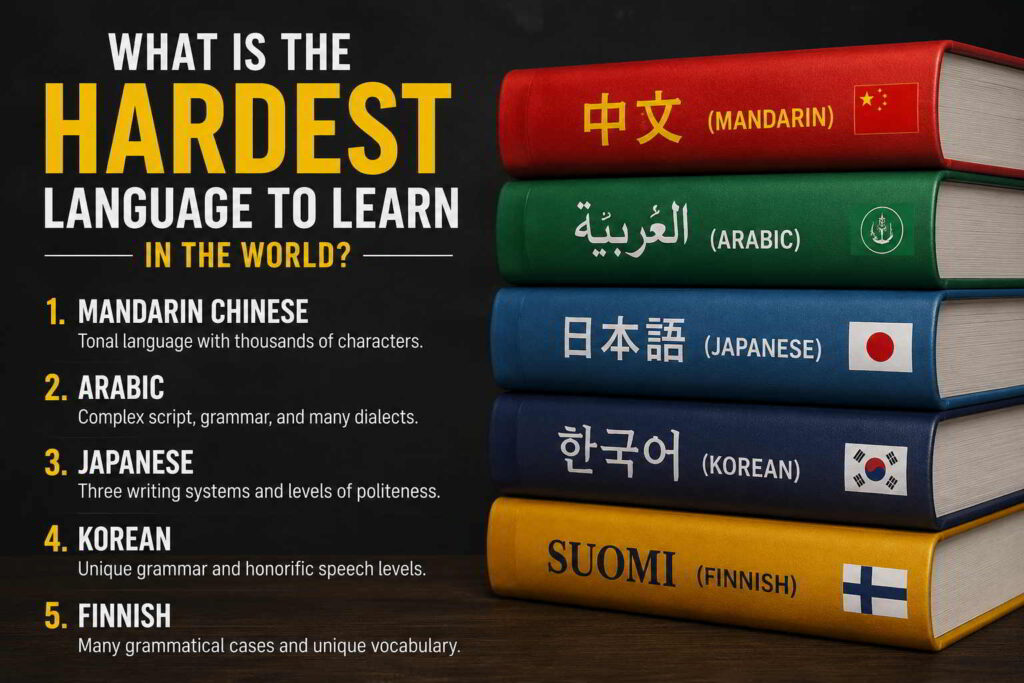
According to the US Foreign Service Institute (FSI), Mandarin Chinese, Japanese, Arabic, and Korean tie for the title of hardest language to learn for native English speakers. Reaching professional proficiency in these Category IV languages requires approximately 88 weeks, or 2,200 class hours, due to complex writing systems, tonal pronunciations, and completely distinct grammar structures.
Picking up a new language is one of the most rewarding things you can do. It unlocks cultures, careers, and conversations you would never have access to otherwise. Many people start with Spanish or French and find themselves holding basic conversations within a few months. That early momentum feels incredible.
But then someone picks up Japanese. Or tries to read an Arabic newspaper. Or sits through their first Mandarin tones lesson. Suddenly, the question becomes much more pressing: what is the hardest language to learn?
Here’s the honest answer — language difficulty is personal. A native Korean speaker will find Japanese relatively accessible because the two languages share structural similarities. A Portuguese speaker will cut through Spanish like butter. Your starting point matters enormously.
That said, linguists and government language programs have spent decades collecting real data on acquisition difficulty, and the patterns are hard to ignore. For native English speakers specifically, certain languages consistently require far more time and effort than others.
This guide breaks down the science behind those rankings. You’ll learn which features make a language difficult, what the official government data actually says, and which specific languages consistently claim the title of the most difficult language to learn. You’ll also walk away with practical strategies to tackle them — because difficult is not the same as impossible.
What specific factors make a language difficult to learn?
Not all linguistic challenges are created equal. Some languages trip up English speakers for one or two specific reasons. Others stack obstacle after obstacle in ways that compound the difficulty significantly. Understanding these core factors helps explain why certain languages sit at the top of every difficulty list.
Linguistic distance is the starting point. Languages belong to family trees. English is a Germanic language with enormous vocabulary contributions from Latin and French. Study Dutch or Norwegian, and your brain immediately finds familiar patterns — shared roots, recognizable structures, similar word order. Study Mandarin or Arabic, and you lose every single one of those familiar handholds. You’re not learning new words for old concepts. You’re building a completely new mental framework from scratch.
Writing systems add another layer of complexity. English uses a 26-letter phonetic alphabet. You see a new word, you sound it out, and you have a reasonable shot at pronouncing it correctly. Many of the hardest languages to learn throw that approach straight out the window. Logograms — used in Mandarin and Japanese — are single characters that represent entire words or concepts. You cannot sound them out. You simply have to memorize them, one by one, by the thousands.
Tones represent a challenge that surprises many beginning learners. English uses pitch to convey emotion or emphasis. In tonal languages, pitch changes the actual dictionary definition of a word. Saying a syllable with a rising pitch might mean “buy.” Saying the exact same syllable with a falling pitch might mean “sell.” Train your ears wrong, and you will say something completely different from what you intended.
Grammar structure is the final major hurdle. English follows a Subject-Verb-Object (SVO) order — “I eat rice.” Languages like Korean and Japanese flip this to Subject-Object-Verb — “I rice eat.” Beyond word order, some of the toughest languages to learn use complex case systems where noun endings change depending on the word’s role in the sentence, or elaborate honorific systems requiring entirely different vocabulary based on social context.
What are the hardest languages to learn overall? The FSI rankings explained
The Foreign Service Institute (FSI) is the US government body responsible for training diplomats and foreign service officers. For decades, the FSI has tracked how long it takes a native English speaker to reach “General Professional Proficiency” in a new language, producing the most widely cited language difficulty ranking in existence.
The FSI divides languages into four categories based on required study hours:
- Category I (600–750 hours): Spanish, French, Italian, Portuguese. These share the most structural overlap with English.
- Category II (~900 hours): German and Indonesian sit here. A step up in complexity, but still manageable.
- Category III (~1,100 hours): Russian, Hindi, Finnish, and Turkish, among others. These introduce genuinely foreign grammar systems and unfamiliar scripts.
- Category IV (~2,200 hours): These are the FSI’s “super-hard languages” — the ones requiring nearly three times as long as Category I languages to master.
Category IV is where things get genuinely daunting. That 2,200-hour figure represents about 88 weeks of intensive, full-time study. These are not languages you pick up with a casual Duolingo habit. They require sustained, dedicated effort over multiple years.
Which is the most difficult language to learn? An in-depth look
Four languages share the top spot in FSI’s Category IV. Each one presents a different — and uniquely brutal — set of challenges for English speakers.
Why does Mandarin Chinese top so many “hardest languages” lists?
Mandarin’s reputation is well-earned. The writing system alone could fill a university course. Mandarin uses Hanzi logograms — each character representing a word or concept rather than a sound. Basic literacy requires memorizing around 2,000 to 3,000 characters. Reading a newspaper comfortably? That jumps to roughly 8,000.
On top of that, Mandarin is a tonal language with four distinct tones plus a neutral tone. The difference between saying “mā” (mother) and “mǎ” (horse) is entirely in your pitch — and confusing them in conversation gets awkward fast.
The silver lining: Mandarin grammar is genuinely simple. No verb conjugations. No gendered nouns. No plural suffixes. Once you crack the characters and tones, the sentence structure itself won’t cause you much grief.
What makes Arabic one of the toughest languages to learn?
Arabic starts with an immediate visual challenge — a completely different alphabet, written right to left, where letters change shape depending on their position within a word. Standard written Arabic also omits short vowels, meaning you need enough contextual understanding to know how a word is actually pronounced from reading it. That’s a significant ask for beginners.
The grammar relies on a beautiful but complex three-consonant root system. By combining a root with different vowel patterns and prefixes, the language generates entire families of related words. Elegant once you understand it; deeply confusing while you’re learning.
The biggest practical challenge for Arabic learners is actually the dialect gap. Modern Standard Arabic (MSA) is used in writing, news, and formal speeches. But no native speaker uses MSA in daily conversation. Instead, people speak regional dialects — Egyptian, Levantine, Gulf, Moroccan — that can differ so dramatically that speakers from opposite ends of the Arab world sometimes struggle to understand each other. Effectively, you’re learning two versions of the language at once.
Why does Japanese require 2,200 hours of study?
Many linguists consider Japanese the single most difficult language to learn for native English speakers, and the writing system is the primary reason. Japanese uses three separate scripts simultaneously. Hiragana handles native grammatical elements. Katakana covers foreign loanwords. Kanji — adopted Chinese characters — carries the bulk of core vocabulary. A single sentence will often contain all three scripts mixed together, and most Kanji characters have multiple different pronunciations depending on context.
Beyond the writing, Japanese features keigo — a deeply layered honorific system. The words, verbs, and sentence structures you use shift dramatically based on your relationship with the listener. The language you use with your manager is fundamentally different from the language you use with a close friend. Mastering that social calibration takes years of immersion, not just grammar drills.
How does Korean compare in terms of language difficulty?
Korean shares Category IV status with Japanese and Mandarin, though it presents a different profile of challenges. The Korean writing system, Hangul, is actually one of the most logical and learner-friendly alphabets in the world. Most students can read Hangul within a few hours of study. That’s a genuine early win.
The difficulty lives entirely in the grammar. Korean uses Subject-Object-Verb sentence structure, which feels completely inverted to English speakers. Verbs sit at the end of sentences, and entire clauses stack on top of each other in ways that take significant mental rewiring to process naturally. Like Japanese, Korean features a complex system of speech levels and honorifics that requires constant social calculation.
What are some other tough languages to learn for English speakers?
The FSI’s Category IV may define the ceiling, but several other languages present formidable challenges worth knowing about.
Why are Finnish and Hungarian notoriously difficult for English speakers?
Most European languages belong to the Indo-European family, which means English speakers can find scattered vocabulary footholds even in languages like Russian or Greek. Finnish and Hungarian belong to the Uralic language family. They share almost zero DNA with English.
Both languages are famous for their case systems. Rather than using prepositions like “in,” “on,” or “at,” Finnish and Hungarian attach grammatical suffixes directly to the ends of nouns. Finnish has 15 noun cases. Hungarian has approximately 18. A single noun can take on dozens of different forms, each carrying a distinct grammatical meaning. It’s a system that requires fundamental rewiring of how you think about expressing location, direction, and relationship.
What makes Basque and Navajo so uniquely complex?
Basque is genuinely one of a kind. Spoken in the border region between Spain and France, it has no known linguistic relatives anywhere on the planet — making it a true language isolate. Its grammar uses an ergative-absolutive alignment system, which handles subjects and objects in a way that has no parallel in any European language. There’s simply no existing knowledge base to lean on.
Navajo presents a different kind of complexity. It’s an intensely verb-based language, where a single verb can carry enough prefixes and suffixes to express what an entire English sentence would need to convey. According to research from UC Irvine, even the simplest Navajo verbs require at least three prefixes, and five or six are common. The pronunciation adds further challenges through tones, nasalized vowels, and glottal stops. This complexity was precisely why the US military used Navajo code talkers to transmit unbreakable encrypted messages during World War II.
What are the best tips for tackling the most difficult languages?
Knowing what you’re up against is half the battle. The other half is building a study approach that actually works over the long haul.
Prioritize consistency over intensity. Studying for 30 focused minutes every single day will carry you further than a marathon four-hour session once a week. Language acquisition builds new neural pathways, and your brain needs frequent, regular exposure to reinforce and solidify those connections over time. Daily habit beats occasional effort, every time.
Immerse yourself in the language before you feel ready. Don’t wait until you’ve memorized a certain number of vocabulary words before exposing yourself to native content. Listen to podcasts in your target language during your commute. Watch films with subtitles. Put on foreign radio while you cook dinner. Even when you understand nothing, your brain is cataloguing the rhythm, cadence, and sound patterns of the language — work that pays dividends later.
Start speaking from day one. This is the advice most beginners resist, and it’s the advice that matters most. Find a language exchange partner online or book sessions with a native-speaking tutor. Making mistakes in a real conversation forces your brain to problem-solve in ways that flashcard apps never can. The earlier you start forming sentences, no matter how clunky they sound, the faster your brain adapts to the new grammatical landscape.
The bottom line on language difficulty
So, what is the hardest language to learn? For native English speakers, the FSI data points clearly to Mandarin, Japanese, Arabic, and Korean. Each demands roughly 2,200 class hours of dedicated study — a number that reflects genuinely foreign writing systems, unfamiliar grammar logic, and pronunciations that require serious ear training.
But here’s the thing worth remembering: that number assumes full-time, structured classroom study. Motivated learners who combine consistent daily practice with genuine immersion and real conversation can accelerate that timeline meaningfully.
Difficulty should inform your preparation, not your decision. The hardest languages to learn are, almost without exception, the ones that open the most extraordinary doors — culturally, professionally, and personally. Pick the language that excites you, understand what lies ahead, and build a study habit that can carry you the distance. The mountain is real, but so is the view from the top.
Frequently Asked Questions (FAQ)
How many hours does it take to learn the hardest languages?
According to the Foreign Service Institute (FSI), native English speakers need approximately 88 weeks — or 2,200 class hours — to reach general professional proficiency in Category IV languages like Arabic, Mandarin, Japanese, and Korean.
Which is harder to learn: Mandarin Chinese or Japanese?
Both require around 2,200 hours of study according to FSI data. Mandarin Chinese is harder due to its tonal system, but offers simpler grammar. Japanese is harder due to three simultaneous writing systems and complex honorifics. Choose Mandarin if grammar simplicity appeals to you; choose Japanese if you can tolerate script complexity but prefer non-tonal pronunciation.
Is Russian considered one of the hardest languages to learn?
Russian is a Category III language according to the FSI, requiring approximately 44 weeks (1,100 class hours) for English speakers to reach professional proficiency. The Cyrillic alphabet, a six-case grammar system, and limited shared vocabulary with English make Russian genuinely difficult — though not quite as demanding as Category IV languages.
Can adults realistically learn a Category IV language?
Yes. While children absorb language effortlessly through natural immersion, adults bring significant advantages: strong study habits, existing world knowledge that aids comprehension, and clear motivation. Adults learning Mandarin, Japanese, Arabic, or Korean routinely reach conversational proficiency with consistent daily practice and structured instruction. The 2,200-hour FSI estimate reflects intensive classroom study — self-directed learners who combine apps, tutors, and immersion can achieve strong results within similar timeframes.
What is the easiest language to learn after mastering a hard one?
Once you’ve mastered a Category IV language, Category I languages feel remarkably accessible. An English speaker who has mastered Mandarin Chinese, for instance, will find Japanese significantly easier due to shared Kanji characters. Similarly, mastering Arabic opens doors to Persian and Hebrew, which share script similarities and some vocabulary roots.